Museum of Blue
Museum of Blue
Museum of Blue
Redesigning Harvard Art Museums’ collection and exhibition through Color
Redesigning Harvard Art Musuem’s collection and exhibition through Color
Redesigning Harvard Art Musuem’s collection and exhibition through Color
Museum of Blue is an AI-powered curatorial system that reindexes museum collections by color semantics. Combining vision language model, pigment-aware inference, and semantic clustering, the project analyzes nearly 4,000 artworks to reveal how blue operates across art history - from skies and water to garments and architecture, generating adaptive museum experiences in real time.
Museum of Blue is an AI-powered curatorial system that reindexes museum collections by color semantics. Combining vision language model, pigment-aware inference, and semantic clustering, the project analyzes nearly 4,000 artworks to reveal how blue operates across art history - from skies and water to garments and architecture, generating adaptive museum experiences in real time.
Museum of Blue is an AI-powered curatorial system that reindexes museum collections by color semantics. Combining vision language model, pigment-aware inference, and semantic clustering, the project analyzes nearly 4,000 artworks to reveal how blue operates across art history - from skies and water to garments and architecture, generating adaptive museum experiences in real time.
ROLE
ROLE
ROLE
Researcher, Product Engineer
Researcher, Product Engineer
Researcher, Product Engineer
SKILLS
SKILLS
SKILLS
Concept development
UI/UX Design
System architecture
Full-stack development
Concept development
UI/UX Design
System architecture
Full-stack development
Concept development
UI/UX Design
System architecture
Full-stack development
TIMELINE
TIMELINE
TIMELINE
2026
2026
2026
TOOLS
TOOLS
TOOLS
FastAPI, Pydantic, React, TypeScript
Three.js, Rhino 3D, Figma
Claude API, Claude Code
FastAPI, Pydantic, React, TypeScript
Three.js, Rhino 3D, Figma
Claude API, Claude Code
FastAPI, Pydantic, React, TypeScript
Three.js, Rhino 3D, Figma
Claude API, Claude Code
RECOGNITION
RECOGNITION
RECOGNITION
Project received endorsement from Assistant Director of Exhibitions and Curator at the Harvard Art Museums. Implementation at HAM in progress.
Project received endorsement from Assistant Director of Exhibitions and Curator at the Harvard Art Museums. Implementation at HAM in progress.
Project received endorsement from Assistant Director of Exhibitions and Curator at the Harvard Art Museums. Implementation at HAM in progress.
01 Overview
01 Overview
01 Overview
Museum of Blue rethinks the Harvard Art Museums through a single color. Instead of browsing by artist, date, or medium, visitors explore how blue appears across roughly 3,900 paintings, as sky, water, clothing, or background, and how its use changes across periods and cultures.
Museum of Blue rethinks the Harvard Art Museums through a single color. Instead of browsing by artist, date, or medium, visitors explore how blue appears across roughly 3,900 paintings, as sky, water, clothing, or background, and how its use changes across periods and cultures.
Museum of Blue rethinks the Harvard Art Museums through a single color. Instead of browsing by artist, date, or medium, visitors explore how blue appears across roughly 3,900 paintings, as sky, water, clothing, or background, and how its use changes across periods and cultures.
Mapping Collection
Mapping Collection
Mapping Collection
Left:
Around 3,900 paintings scraped from the Harvard Art Museums API, with full metadata, as the raw input for everything that follows.
Right:
A 2D semantic projection where each blue object is a point, similar objects cluster together, and color shows cultural origin.
Left:
Around 3,900 paintings scraped from the Harvard Art Museums API, with full metadata, as the raw input for everything that follows.
Right:
A 2D semantic projection where each blue object is a point, similar objects cluster together, and color shows cultural origin.
Left:
Around 3,900 paintings scraped from the Harvard Art Museums API, with full metadata, as the raw input for everything that follows.
Right:
A 2D semantic projection where each blue object is a point, similar objects cluster together, and color shows cultural origin.
Scroll Left
Scroll Left


02 Solution
02 Solution
02 Solution
I built a pipeline that pulls each painting and its metadata from the Harvard Art Museums API, uses a vision-language model (Gemini 2.5 Pro) to identify blue objects and their RGB values, and clusters the results with semantic embeddings and UMAP. The resulting dataset powers a dashboard and a set of stories comparing blue across artists, timelines, and cultures.
The client’s four products (bridge, floor, deck, boardwalk) are one system: a hanger, trusses in its slots, another hanger, repeated. I built a single resolver, and product types became JSON presets over it.
The client’s four products (bridge, floor, deck, boardwalk) are one system: a hanger, trusses in its slots, another hanger, repeated. I built a single resolver, and product types became JSON presets over it.
Prototyping
Prototyping
Prototyping
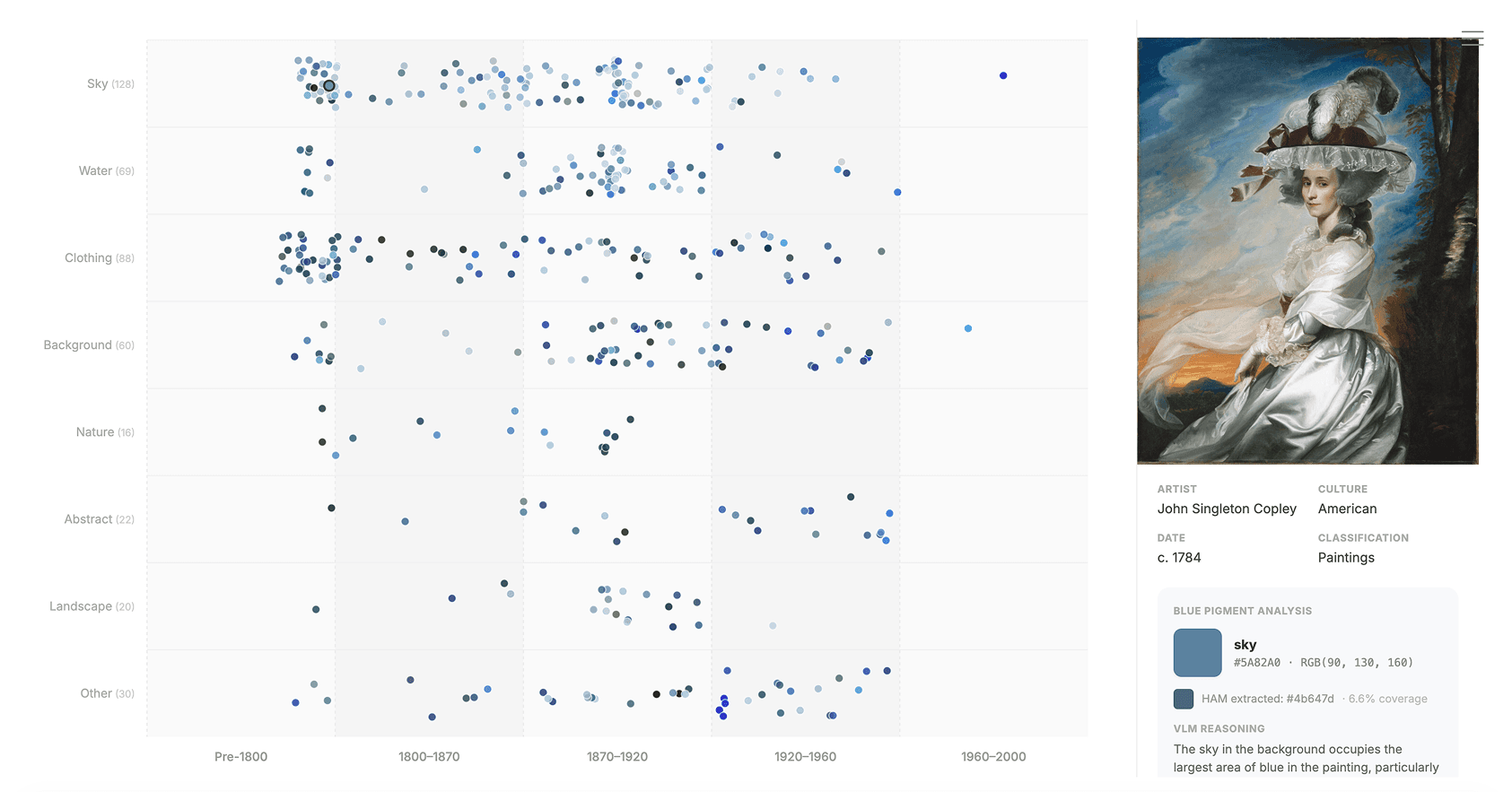
The prototype plots every blue object by subject, from sky and water to clothing and landscape, across time from before 1800 to 2000. Selecting a point opens the painting with its metadata, a blue pigment analysis, and the model’s reasoning. The same data powers the adaptive gallery experiences below.
A few rounds in, I realized the real need wasn’t an AI platform that assembles two drawing sets. It was linking three things that had never been linked:
Data management, storage, and product configuration
Sales quotes and customer communication
R&D file intake and multi-team operations
A few rounds in, I realized the real need wasn’t an AI platform that assembles two drawing sets. It was linking three things that had never been linked:
Data management, storage, and product configuration
Sales quotes and customer communication
R&D file intake and multi-team operations
Scroll Left
Scroll Left